Guardians of the Galaxy: The Post-Credit Joke and the Museum Behind It
By 2014 the post-credit scene had become an obligation. This film used the space for a joke about a commercial disaster, and filled an earlier shot with everything it could not otherwise mention.
Introduction
Six years after the convention was established as a marketing instrument, a film in the same series used its post-credit slot for something else entirely: a gag whose punchline is a character from one of the most notorious commercial failures in American film history.
That choice tells you something about how the convention had evolved. A tease is only valuable if a studio has something to tease, and by this point the studio had so much in development that it could afford to spend the slot on a joke.
This guide covers the post-credit scene, the museum sequence earlier in the film that functions as a second and denser Easter egg, and the cameos its director brought with him from a much smaller corner of the industry.
Spoiler warning
This guide discusses mid-film revelations and some plot turns. It describes the post-credit scene in full and refers to events in the film’s final act. The detail-by-detail section below stays hidden until you choose to open it.
Film context
The film was directed by James Gunn, whose earlier career included writing and directing for Troma Entertainment, a small studio specializing in deliberately crude low-budget features. That background is directly relevant to several details in this guide.
It was released in August 2014 and was widely regarded as a commercial risk, being based on comics with limited recognition and populated largely by characters no general audience had heard of. Its success altered the studio’s appetite for obscure material.
By this point the post-credit scene was a fixed expectation, and audiences stayed by default. That expectation is what allows the film’s post-credit joke to work, since the gag depends on the viewer having sat through eight minutes of credits for it.
The film also arrives after several years of accumulated screen continuity, which is why a single shot of a collection can be loaded with references to characters and objects introduced elsewhere.
The details, one by one
Each entry below carries an approximate on-screen time and a label marking whether the detail has been confirmed by the people who made the film or remains an informed reading. Running times vary between theatrical cuts, home releases, and restorations, so treat every timestamp as a signpost rather than a precise measurement.
It describes the post-credit scene in full and refers to events in the film’s final act. Open this section when you are ready to read the details in full.
Times refer to the theatrical version, which runs about 121 minutes before the credits.
The post-credit scene revives a 1986 failure
The scene shows the collector sitting in the wreckage of his gallery, addressed by a talking duck in a glass, who then delivers a single dismissive line. The character is Howard the Duck, who had headlined a 1986 feature produced by Lucasfilm that became a byword for expensive failure.
Gunn has confirmed choosing the character himself and has described it as a joke aimed at people who remembered the earlier film. The character is a genuine comics property with a long publication history, which is what makes the gag defensible rather than merely obscure.
It is worth noting how completely the scene inverts the convention. It advances nothing, promises nothing, and functions purely as a reward for having stayed.
On the record: Gunn has confirmed selecting the character in interviews around the film’s release, including on social media and in press coverage.
The museum shot is loaded with other films’ material
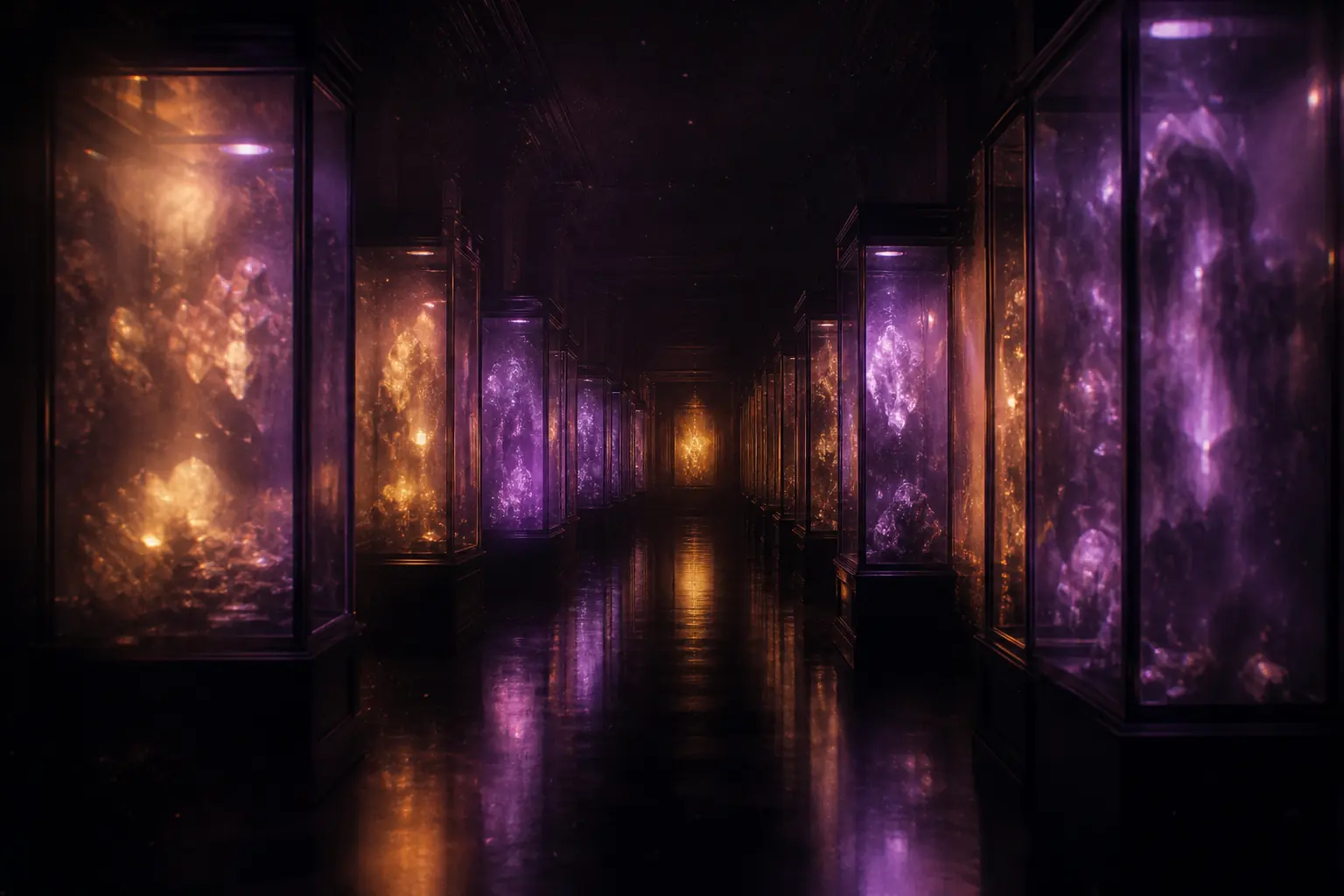
The collector’s gallery is filled with specimen cases, several of which contain identifiable characters and creatures introduced in other films in the same series, including a member of a species seen in an earlier entry and a captive from a different one.
One case holds a dog in a Soviet-era spacesuit collar, a character from the comics associated with a Russian space program. Another holds a creature type from an earlier film in the series.
The shot is a deliberate density exercise, and the studio has acknowledged its contents. It is also a good demonstration of how franchise Easter eggs differ from other kinds: they reference other products rather than other art.
On the record: The cases and their occupants have been identified in the film’s production material and confirmed in interviews with the production team.
The director brought cameos from his earlier career
Lloyd Kaufman, the founder of the studio where Gunn began his career, appears as a prisoner in the detention sequence. The film also uses uncredited voice cameos from performers with whom Gunn had previously worked.
Casting from one’s own history is a common director trademark, and it functions here as a signature rather than a reference: nobody in the audience is expected to recognize these faces except the people who worked on those earlier films.
Gunn has confirmed the cameos, and the pattern continues across his subsequent work.
On the record: The cameos are credited or have been confirmed by Gunn in interviews and on social media.
Two voices in the film belong to recognizable performers
A heavily made-up prisoner is voiced by Nathan Fillion, uncredited on screen, and a member of the pirate crew is voiced by the musician and filmmaker Rob Zombie, continuing a pattern from Gunn’s earlier films.
Voice cameos are the most durable kind of hidden detail in a franchise film, because they survive prosthetics, editing, and reshoots. They are also the easiest to confirm, since performers tend to mention them.
Both have been confirmed publicly, and the Rob Zombie appearance in particular has recurred across Gunn’s filmography as a running signature.
On the record: Both voice cameos have been confirmed by Gunn and by the performers in interviews and public statements.
The Stan Lee cameo is staged as a passing joke
Stan Lee appears in a brief shot on a crowded street, in conversation with a woman, and the scene is framed as a joke at his character’s expense. The appearance is one of a long series across the studio’s films.
Lee’s cameos are worth treating as a category rather than as individual details, since their function changed over time from an in-joke for readers to an expected event with its own audience reaction.
This one is notable only for how casually it is staged, in a film that otherwise takes place almost entirely away from Earth.
On the record: The cameo appears in the film and is credited; the series-long practice is documented in the studio’s published material.
The convention had split into two slots by this point
By 2014 the studio was routinely placing one scene immediately after the main cast credits and another at the very end, after the full crew roll. The two slots came to serve different purposes: the earlier one for narrative material and the later one for jokes.
This film uses only the final slot, which is part of why the joke lands. The audience has been trained to expect a plot tease and receives a duck instead.
The split is documented across the series and has since been adopted widely enough that audiences now distinguish between the two positions without being told.
On the record: The two-slot practice is observable across the studio’s releases and is documented in trade coverage of the period.
Claimed contents of the museum shot
Compiled lists identify a great many additional occupants of the gallery, including specific comics characters visible only as silhouettes or partial shapes in the background of the shot.
Some identifications are confirmed by the production. Many depend on freeze-framing an out-of-focus case and matching a shape, and the production has not endorsed them.
A dense set-dressing shot invites this kind of reading, and the honest position is that the confirmed occupants are documented and the rest are guesses.
On the record: The production has confirmed several occupants of the gallery; additional identifications circulating in compiled lists lack confirmation.
Connections to other films
Our Iron Man guide covers the beginning of this convention in the same series, when a post-credit scene was still a surprise rather than an obligation. The two films show the device at opposite ends of its usefulness.
Our Endgame guide covers the other end again, where the same studio removed the scene entirely and replaced it with a sound. Read in sequence, the three guides describe the full arc of a convention.
The Howard the Duck reference also connects to a much older piece of film history, since the 1986 feature was produced by the company behind A New Hope. The joke is partly about how quickly a studio’s reputation can turn.
Cultural references explained
The 1986 film the post-credit scene references has an unusual cultural position: widely mocked, commercially disastrous, and now regarded with a certain affection by people who saw it as children. Reviving the character was a joke about failure that also treated the failure kindly.
The film’s soundtrack, built from 1970s pop singles presented as a mixtape belonging to the protagonist, revived commercial interest in several of those recordings and established a template imitated widely afterward. The device is a plot object rather than a marketing decision, which is why it works.
The Troma cameos point to a real professional pipeline. A number of filmmakers who went on to large studio work began in deliberately disreputable low-budget production, and casting those colleagues later is a way of acknowledging the route.
Confirmed facts and interpretation
This film’s details are unusually easy to confirm because its director discussed them publicly and at length while the film was in release, often in direct response to questions from viewers.
The exception is the museum shot, which is exactly the kind of dense background image that generates unverifiable identifications. Several occupants are confirmed; a long tail of claimed ones is not.
On the record
- The post-credit scene features Howard the Duck, chosen by James Gunn as a reference to the 1986 feature.
- The collector’s gallery contains characters and creatures introduced in other films in the same series.
- Lloyd Kaufman, founder of the studio where Gunn began his career, appears as a prisoner.
- Nathan Fillion and Rob Zombie provide uncredited voice cameos.
- Stan Lee appears in a brief street cameo, part of a series-long practice.
- By this point the studio was routinely using two separate post-credit slots for different purposes.
Interpretation, not fact
- Identifications of additional gallery occupants visible only as background shapes.
- That the post-credit scene was intended to set up a future appearance for the character.
- That specific soundtrack choices comment on individual scenes beyond their stated use as a mixtape.
Sources consulted
The material below informed this guide. Where a claim rests on a single account, the guide says so in the relevant entry.
- Interviews and public statements by James Gunn, 2014–2017Press coverage and the director’s own social accounts. Primary source for the post-credit choice, the cameos, and the gallery contents.
- Guardians of the Galaxy: The Art of the MovieMarvel. Production art and design material, including the collector’s gallery set.
- Contemporary trade coverage, 2014Variety, The Hollywood Reporter. Documents the film’s commercial position and the studio’s post-credit practice at the time.
- Howard the Duck (1986)Universal Pictures / Lucasfilm. Consulted as the reference behind the post-credit joke.
- Published histories of Troma EntertainmentVarious. Background on the studio where the director began and the colleagues who appear in the film.
Spotted an error or have a documented source we should add? Write to [email protected] and read our corrections policy.