Pulp Fiction: The Trademarks Quentin Tarantino Carries Between Films
Tarantino built a set of props, brands, and camera positions that travel between his films. This guide identifies them where they appear in his 1994 picture and explains what the repetition is for.
Introduction
Some directors have trademarks that they would rather not discuss. Tarantino has trademarks that function as a running joke with his audience, and he has talked about most of them at length.
The interesting question is why a filmmaker would build a private inventory of fictional consumer products and reuse them for thirty years. The answer, on the evidence of his own statements, is that it constructs a single continuous fictional world without requiring any of the films to acknowledge one another.
This guide identifies the trademarks visible in Pulp Fiction, notes roughly where each appears, and separates the ones the director has confirmed from the patterns critics have assembled. Where the film has been misreported, and it has been, the guide says so.
Spoiler warning
This guide discusses mid-film revelations and some plot turns. It discusses the film’s structure and several outcomes out of chronological order. The detail-by-detail section below stays hidden until you choose to open it.
Film context
Tarantino wrote the screenplay with Roger Avary following Reservoir Dogs, structuring it as three interlocking stories presented out of chronological order. It was made for a modest budget through Miramax, and its success in 1994 reshaped American independent film distribution for the rest of the decade.
The production company he formed for the film took its name from Jean-Luc Godard’s Bande à part, which is a useful indication of how deliberately he was situating himself in a tradition. His references run simultaneously to European art cinema, American crime paperbacks, and 1970s exploitation pictures.
The film is shot in a small number of tightly controlled locations, mostly interiors, with long dialogue scenes held in wide masters. That formal restraint is what makes the recurring visual signatures legible: when the camera does something unusual, it is doing it deliberately.
It won the Palme d’Or at Cannes and the screenplay Oscar, and it made its director a public figure whose habits were immediately catalogued by audiences. That attention is why the trademarks became a game rather than a private joke.
The details, one by one
Each entry below carries an approximate on-screen time and a label marking whether the detail has been confirmed by the people who made the film or remains an informed reading. Running times vary between theatrical cuts, home releases, and restorations, so treat every timestamp as a signpost rather than a precise measurement.
It discusses the film’s structure and several outcomes out of chronological order. Open this section when you are ready to read the details in full.
Times refer to the theatrical version, which runs about 154 minutes.
A hamburger brand that exists only in his films
The paper bag and cup on the apartment table carry the logo of Big Kahuna Burger, a Hawaiian-themed fast-food chain that has never existed. It had already appeared in Reservoir Dogs, and it turns up again in later films across his filmography.
The reason for inventing a brand rather than clearing a real one is partly practical, since no chain wants its packaging in that scene, and partly structural. A fictional product that appears in multiple films implies that those films share a world without any character ever having to say so.
Tarantino has confirmed the intent, describing the recurring brands as a way of linking his pictures into what he treats as two connected universes, one realistic and one that the characters in the realistic films would watch at the cinema.
On the record: The packaging is visible in multiple films, and Tarantino has described the recurring fictional brands and the two-universe structure in interviews, including with Vulture and in his Cannes press conferences.
A cigarette brand as a running signature
Red Apple cigarettes, another invented product, appear in the film and recur across his work, eventually receiving a full mock advertisement in a later picture. Like the burger chain, the brand has no existence outside the films.
The choice of a cigarette brand is period-appropriate in a specific way. Tobacco advertising was a dominant visual language in the American mid-century, and inventing a brand allows the films to reference that world without licensing a real one that carries its own history.
The brand has become one of the most reliable ways to identify a Tarantino production from a single frame, which makes it a trademark in the commercial sense as well as the authorial one.
On the record: The brand appears across several of the director’s films and has been discussed by him as a deliberate recurring element; a fictional advertisement for it was produced for Once Upon a Time in Hollywood.
The camera in the trunk
Twice in the film, characters open a car trunk and are photographed from inside it, looking up. The position appears in almost every feature he has made, and it is one of the few visual signatures in modern American cinema recognizable enough to be parodied.
The shot does specific work. It places the audience inside the space where a body would be, and it makes an ordinary action, retrieving something from a car, feel like an inspection. Used twice in one film, it also builds a rhyme between two sets of characters.
Tarantino has acknowledged the repetition as intentional. It is the clearest case in his filmography of a trademark that is purely formal rather than a prop or a brand.
On the record: The camera position recurs across the director’s features and has been discussed by him and by his cinematographers as a deliberate signature.
The briefcase contents were never decided
The case that drives the plot is opened several times and emits a warm light, and its contents are never shown or named. Tarantino has stated that the contents are deliberately unspecified and that the glow was added so the audience would stop asking.
This is a MacGuffin in the Hitchcock sense, used more brazenly. Where Hitchcock kept his secrets vague, this film draws attention to the emptiness by making the case visibly luminous and then refusing to explain it.
The widely repeated claim that the light references a specific 1955 film noir is a critical comparison rather than a confirmed source. The comparison is worth knowing; the attribution is not documented.
On the record: Tarantino has said in interviews that the contents were intentionally left undefined; the comparison to earlier noir originates in film criticism rather than in his statements.
The film shares a family with Reservoir Dogs
The surname of one of the film’s central characters matches that of a character in Reservoir Dogs, and Tarantino has confirmed that the two were written as brothers. He developed and eventually abandoned a project about the pair.
The link is invisible inside either film. Neither mentions the other, and the connection exists entirely in the surname and in the director’s statements, which makes it a pure example of extra-textual continuity.
It is also a reminder that a shared universe need not do any narrative work. Nothing in either film changes if you know, which is arguably why the connection has survived as a piece of trivia rather than becoming a franchise.
On the record: Tarantino has repeatedly confirmed the family relationship and the abandoned project in interviews from the mid-1990s onward.
The restaurant is a museum of borrowed images
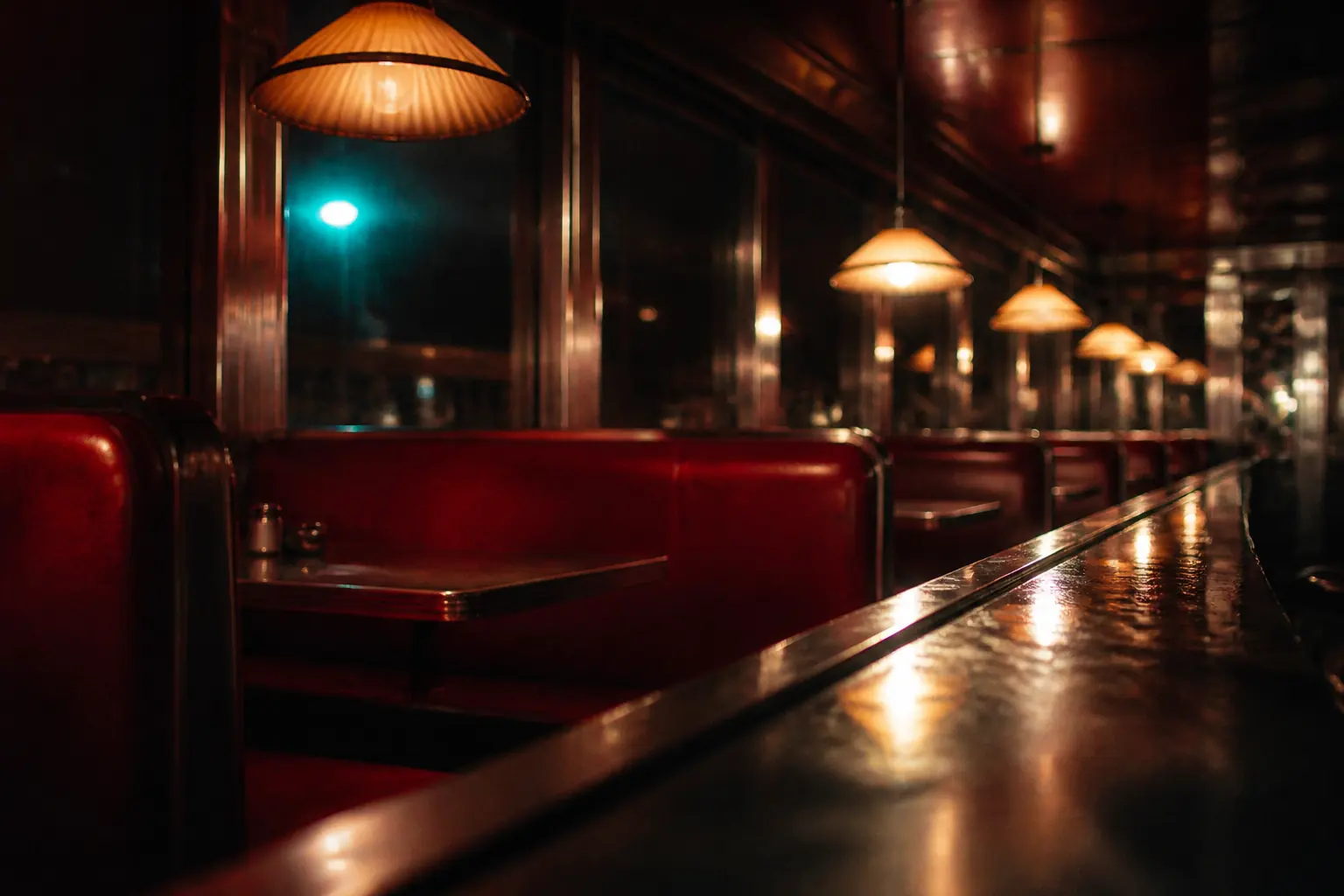
The nightclub sequence takes place in a themed restaurant staffed by performers impersonating 1950s figures, with diners seated in converted cars. The set was built for the film and dressed with period signage and vehicles.
It is an unusually literal statement of method. The film is set in the 1990s, in a restaurant that sells nostalgia for the 1950s, and both the characters and the film are consuming the same recycled imagery at the same time.
The dance sequence staged there has been compared to several earlier films. Tarantino has spoken about wanting the scene to feel like a musical number interrupting a crime picture, and has cited his affection for dance sequences in older films without designating a single source.
On the record: The set construction is documented in production coverage of the film; Tarantino’s comments on the dance sequence appear in interviews from the film’s release and later retrospectives.
The recurring attention to feet
Shots that isolate characters’ bare feet appear here and across the filmography frequently enough that audiences have long treated it as a signature. In this film the most cited instance occurs during the restaurant sequence.
The pattern is real and easy to document by simply counting. What has not been established is a stated artistic purpose. Tarantino has responded to the observation in interviews with jokes and with references to other directors who did the same, rather than with an explanation.
We list it as an observable recurrence rather than a confirmed intention. The distinction matters: a pattern can be undeniable and still lack a documented reason.
On the record: The recurrence is observable across the films; the director has addressed it in interviews without offering a definitive account of its purpose.
Connections to other films
Reservoir Dogs is the essential companion, both for the shared surname and because the invented brands begin there. Watching the two in production order shows the trademarks being established rather than referenced.
Godard is the acknowledged art-cinema reference point, from the production company’s name onward. The willingness to interrupt a crime plot with a dance, a lecture, or a long domestic conversation belongs to that tradition rather than to American genre film.
The film’s structural inheritance runs back to crime paperbacks of the mid-twentieth century, and its title says so. Those magazines and novels used interlocking short narratives and abrupt tonal shifts as a matter of format, and the film reproduces the shape of a printed anthology rather than of a novel.
Cultural references explained
The 1950s revival the restaurant sequence satirizes was a genuine commercial phenomenon in the United States in the 1980s and 1990s, with themed diners and reissued products marketed to people too young to remember the decade. The film is documenting a real industry, not inventing one.
The dialogue’s attention to fast food, television pilots, and imported product names is doing sociological work. Characters establish their positions through consumer knowledge rather than biography, which is one reason the film reads as a portrait of a specific moment despite containing almost no topical references.
The soundtrack, built largely from surf rock and 1960s and 1970s singles, revived commercial interest in several of those recordings. It also established a template for the compilation soundtrack as a marketing object, which became standard practice for the next decade.
Confirmed facts and interpretation
Tarantino is one of the most interviewed directors alive, which makes his trademarks unusually easy to document. He has confirmed the recurring brands, the shared surnames, the camera position, and the empty briefcase in his own words on multiple occasions.
The places where caution is required are the source attributions. Because his films are dense with quotation, critics have proposed specific origins for images that he has never named, and those proposals circulate as facts. This guide keeps them separate.
On the record
- Big Kahuna Burger and Red Apple cigarettes are invented brands that recur across the director’s filmography.
- The trunk-mounted camera position is a deliberate recurring signature.
- The briefcase contents were intentionally left undefined, with the glow added as a visual solution.
- The character shares a surname with a Reservoir Dogs character and the two were written as brothers.
- The production company was named after Godard’s Bande à part.
- The themed restaurant was a purpose-built set dressed with period signage and vehicles.
Interpretation, not fact
- That the briefcase glow deliberately references a specific 1955 film noir.
- That the recurring shots of feet carry a stated artistic purpose.
- That the dance sequence restages one particular earlier film rather than a general tradition.
Sources consulted
The material below informed this guide. Where a claim rests on a single account, the guide says so in the relevant entry.
- Interviews with Quentin Tarantino, 1994–2019Sight and Sound, Film Comment, Vulture. Primary source for the recurring brands, the shared-universe structure, and the briefcase.
- Pulp Fiction screenplay, by Quentin Tarantino and Roger AvaryMiramax Books. Published text used to verify which details originate in the script rather than on set.
- Cannes Film Festival press conference transcripts, 1994Festival de Cannes. Contains the director’s contemporary account of the film’s structure and influences.
- Contemporary production coverage, 1994Variety, Premiere. Documents the set construction and the film’s budget and shooting schedule.
- Bande à part (1964), directed by Jean-Luc GodardAnouchka Films. Consulted as the acknowledged source of the production company’s name and of the interruption technique.
Spotted an error or have a documented source we should add? Write to [email protected] and read our corrections policy.