Raiders of the Lost Ark: The Hidden Details in a Serial Homage
A film built as a tribute to Saturday serials contains an unusual number of jokes aimed at people who would watch it twice. This guide identifies them, with the production record attached.
Introduction
Steven Spielberg and George Lucas made this film as a deliberate revival of a defunct commercial form, and its hidden details reflect that: some are tributes to the serials, some are private jokes between two filmmakers at the peak of their collaboration, and several are simply traces of a difficult shoot that stayed in the finished picture.
It is also the film in this library whose most famous detail is a production accident. Its best-remembered action beat exists because its lead was too unwell to perform the sequence as written, and the replacement is now the moment everybody quotes.
This guide covers the deliberate material and the accidental material separately, since both are genuinely on screen and only one of them was planned.
Spoiler warning
This guide discusses mid-film revelations and some plot turns. It discusses the final act, including what happens to the artifact. The detail-by-detail section below stays hidden until you choose to open it.
Film context
The film came out of a conversation between Lucas and Spielberg in 1977, in which Lucas described a project modeled on the adventure serials of the 1930s and 1940s. Lawrence Kasdan wrote the screenplay from a long story conference between the three of them, a transcript of which has since circulated and is unusually revealing about how the film was designed.
It was made on a tight schedule and budget by the standards of its ambition, shot in France, Tunisia, England, and Hawaii across 1980. Spielberg has described deliberately working faster and with fewer takes than on his previous films, partly in response to criticism of his earlier production overruns.
The Tunisian shoot coincided with widespread illness among the cast and crew, which is directly relevant to one of the film’s most celebrated scenes. Conditions were difficult enough that the production has been described in those terms consistently by everyone involved.
It was released in June 1981 and became the highest grossing film of the year. Its structure, a sequence of self-contained set pieces linked by travel, has been the template for adventure filmmaking ever since.
The details, one by one
Each entry below carries an approximate on-screen time and a label marking whether the detail has been confirmed by the people who made the film or remains an informed reading. Running times vary between theatrical cuts, home releases, and restorations, so treat every timestamp as a signpost rather than a precise measurement.
It discusses the final act, including what happens to the artifact. Open this section when you are ready to read the details in full.
Times refer to the theatrical version, which runs about 115 minutes.
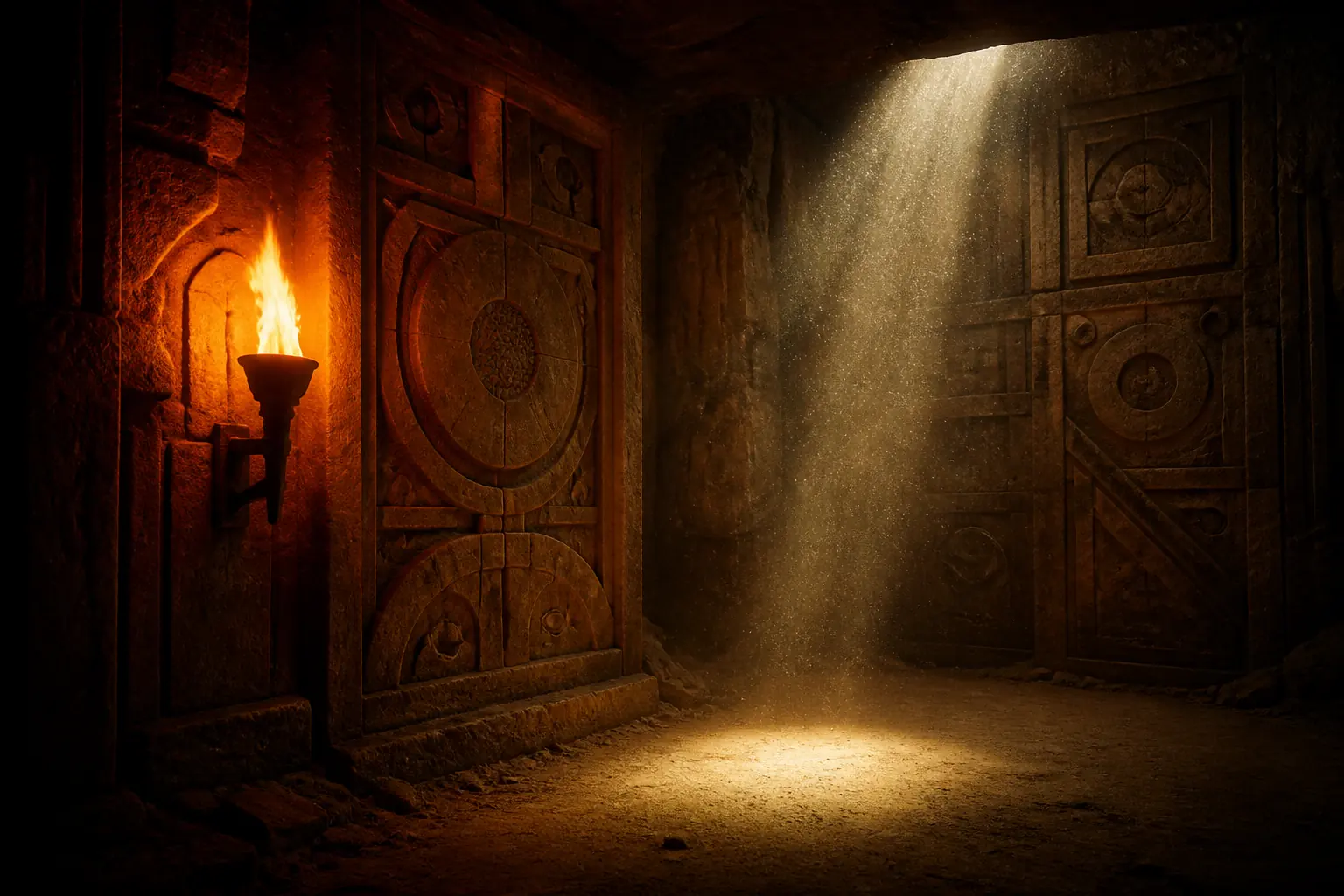
Two droids are carved into the wall of the Well of Souls
On a pillar in the chamber where the artifact is found, among the hieroglyphs, are carved figures recognizable as the two droids from Star Wars. They are placed at roughly eye level and are visible in the finished film.
The joke is a reciprocal one between the two filmmakers, and it belongs to the same exchange documented in our E.T. guide, where one film’s toys appear in another and are answered years later.
The carving has been confirmed by the production and is one of the most frequently cited hidden details in mainstream cinema. It is also a good example of a reference that is easier to see now, on a high-resolution release, than it ever was in a theater.
On the record: The carvings are visible in the film and have been confirmed as a deliberate placement in production interviews and in Lucasfilm’s archival material.
The most quoted scene exists because its star was ill
The confrontation in which a swordsman performs an elaborate display and is shot without ceremony was scripted as a lengthy fight sequence involving a whip and a sword. Harrison Ford, suffering from dysentery during the Tunisian shoot, proposed the shorter version.
The account has been given consistently by Ford, Spielberg, and the crew for four decades, including the detail that the sequence was shot quickly because nobody was in a condition to spend the day on it.
It is the best available demonstration that a film’s most memorable moment can be a solution to a logistical problem rather than an authored idea.
On the record: Ford, Spielberg, and crew members have described the circumstances consistently in interviews and in the production documentaries accompanying the film’s releases.
The monkey performs a salute
During the Cairo sequence, a capuchin monkey working for the antagonists raises an arm in a fascist salute. The gesture was trained for and is held long enough to be unmistakable.
It is a comic detail in a film that is otherwise careful to keep its villains genuinely threatening, and it belongs to the serial tradition, where broad visual jokes about the enemy were standard.
The detail is documented in the production material, and the animal’s training for the gesture has been described by the crew.
On the record: The gesture is visible in the film and its staging is documented in production interviews and material about the Cairo sequence.
The character is named after a dog
The protagonist’s first name comes from an Alaskan malamute belonging to George Lucas, the same animal that had earlier influenced the design of a character in Star Wars.
The film eventually acknowledges this in a later entry in the series, in a line of dialogue that makes the origin part of the fiction. That is an unusual move: a piece of production trivia promoted to canon.
Lucas has confirmed the origin repeatedly, and the dog is well documented in accounts of his working life in the 1970s.
On the record: Lucas has confirmed the name’s origin in numerous interviews, and the connection is documented in Lucasfilm’s archival histories.
The studio logo dissolves into the first shot
The film opens by matching the studio’s mountain logo to a real mountain in the first shot, so that the logo becomes part of the picture. Every subsequent film in the series repeats the device with a different object.
It is a serial-era gesture in spirit: the old chapter films began with a flourish that announced the tone before the story. Here it also functions as a running signature across a franchise.
The device is deliberate and has been discussed by the production, and it is one of the few franchise trademarks that lives in a studio logo rather than in the film.
On the record: The match dissolve is visible in each film in the series and has been discussed as a deliberate running device in production interviews.
The final crate returns twenty-seven years later
The film ends with the artifact nailed into a wooden crate stenciled with a classification and a serial number, and wheeled into a vast government warehouse. The image is the film’s last joke: the object that killed everyone who touched it becomes an inventory problem.
The same warehouse, and a crate matching the description, appear in the fourth film in the series, released in 2008, which turns a closing gag into franchise continuity.
Both appearances are verifiable, and the later film’s reference has been confirmed by its production as a deliberate callback.
On the record: The crate and warehouse appear in the 1981 film, and the 2008 film’s reference to them has been confirmed in its production material.
Claimed serial sources for individual scenes
Compiled lists frequently attribute individual set pieces to specific chapter serials, naming particular titles as the source of the truck chase, the idol theft, or the boulder.
The film’s general debt to the serials is confirmed and was the founding premise of the project. Specific attributions are another matter: the conventions being borrowed appeared across dozens of serials, and the filmmakers have described the tradition rather than particular films.
The story conference transcript is the best evidence available, and it discusses types of scene rather than sources to copy.
On the record: The story conference transcript documents the general serial model; specific per-scene attributions circulating online lack confirmation.
Connections to other films
Our guide to A New Hope covers the other half of this collaboration, including the same debt to chapter serials and the same habit of citing older films openly. The two films are best understood as one project in two genres.
The reciprocal-reference relationship with E.T. is documented in this library as well, and the droid carvings here are part of the same running exchange.
Within the adventure genre, the film’s influence is total. The set-piece structure, the globe-trotting montage, and the archaeologist as action hero all descend from it, and its own sequels spend a good deal of energy referencing it directly.
Cultural references explained
The chapter serials the film revives were a specific commercial product, screened weekly to children alongside cartoons and newsreels, and abandoned by the mid-1950s when television replaced them. Reviving their conventions in 1981 was an act of deliberate archaeology.
The film’s depiction of archaeology belongs to an earlier era in more than one sense. Its hero removes artifacts from their countries of origin as a matter of course, a practice the film treats as heroic and which is now the subject of active international dispute.
Its 1936 setting places it just before the war, in the brief period when adventure fiction could use the emerging Nazi threat as an antagonist without confronting what followed. The serials did exactly the same thing at the time, which is part of what the film is reproducing.
Confirmed facts and interpretation
The production is well documented, including through an unusually candid story conference transcript that shows the three principals designing the film in real time. Most claims here can be traced to first-hand accounts.
The interpretation column concerns source attribution. A film built as a tribute to a whole tradition invites claims that specific scenes copy specific titles, and those claims are rarely supported.
On the record
- Carvings of the two Star Wars droids appear among the hieroglyphs in the Well of Souls.
- The scripted whip-and-sword fight was replaced with a gunshot because Harrison Ford was ill during the Tunisian shoot.
- A monkey performs a trained fascist salute during the Cairo sequence.
- The protagonist’s first name comes from George Lucas’s dog.
- The studio logo is match-dissolved into the opening shot, a device repeated across the series.
- The crate and warehouse from the final scene reappear in the fourth film in the series.
Interpretation, not fact
- That individual set pieces copy specific named chapter serials.
- That background hieroglyphs beyond the droid carving contain further references.
- That the closing warehouse shot was planned as a sequel setup in 1981.
Sources consulted
The material below informed this guide. Where a claim rests on a single account, the guide says so in the relevant entry.
- Raiders of the Lost Ark story conference transcript, 1978Circulated archival document. Record of the design conversation between Lucas, Spielberg, and Kasdan; the best evidence of the film’s intended model.
- Indiana Jones production documentaries and archival featuresParamount Pictures / Lucasfilm. Interviews covering the Tunisian shoot, the gunfight, and the film’s set pieces.
- Interviews with Harrison Ford and Steven Spielberg, 1981–2021Empire, American Film Institute. Consistent first-hand accounts of the illness during production and its consequences.
- Lucasfilm archival historiesDel Rey / Lucasfilm. Documents the droid carvings and the origin of the character’s name.
- Scholarship on American chapter serialsAcademic film histories. Background on the tradition the film revives and its conventions.
Spotted an error or have a documented source we should add? Write to [email protected] and read our corrections policy.