The Shining: The Hidden Details Built Into the Overlook Hotel
No film has generated more amateur detective work than Stanley Kubrick’s adaptation of Stephen King’s novel. This guide separates the details that are genuinely on screen and documented in production records from the readings that grew up around them.
Introduction
There is a particular kind of viewer that The Shining creates. You watch it once and register a haunted hotel. You watch it again and start noticing that the building itself is wrong: a window where no window could be, a corridor that cannot connect to the room it opens onto, furniture that migrates between shots. By the third viewing you are no longer watching a ghost story. You are auditing a floor plan.
That instinct is not misplaced. Kubrick was famous for controlling every measurable element of a frame, and the film contains a great deal of deliberate design that rewards attention. But the same instinct has also produced four decades of readings that treat every visible oddity as an encoded message, and the difference between those two things matters. A detail can be undeniably present on screen and still have no documented intention behind it.
This guide works through the most discussed details in the film one at a time. For each, it states what is actually visible, roughly when it appears, and what the people who made the film have said on the record. Where nobody involved in the production ever addressed a detail, the guide labels the reading as interpretation and leaves it there.
Spoiler warning
This guide discusses the ending and major plot turns in detail. It describes the final act, the photograph that closes the film, and the fate of the Torrance family. The detail-by-detail section below stays hidden until you choose to open it.
Film context
Kubrick began developing the film in 1977, shortly after the commercial disappointment of Barry Lyndon. He wanted a project with obvious audience appeal and settled on Stephen King’s recently published novel, working on the screenplay with the novelist Diane Johnson rather than with King. That decision shaped everything that followed: the film keeps the hotel, the family, and the isolation, and discards much of the book’s explanatory machinery.
Almost the entire production was built at EMI Elstree Studios outside London, where the crew constructed the Overlook’s interiors as a set of connected stages under production designer Roy Walker. The exteriors were photographed at Timberline Lodge on Mount Hood in Oregon, and the aerial approach at the beginning was shot in Glacier National Park in Montana. Nothing about the Overlook exists as a single building anywhere, which is the practical reason its geography can behave so strangely.
The shoot was long even by Kubrick’s standards, running roughly a year with extensive retakes, and a stage fire destroyed part of the set partway through. It also became one of the first productions to lean heavily on the Steadicam, the stabilizing camera rig invented by Garrett Brown, who operated it himself for the film. Those low, gliding shots through corridors are not simply a stylistic flourish; they are the reason the hotel reads as a continuous, navigable space even when its layout does not add up.
The film opened in the United States in May 1980 to divided reviews and steadily better business. Kubrick trimmed it after the first days of release, and the version shown outside North America was shorter still. That editing history is worth knowing before you compare timestamps with anyone else, because several widely cited details sit at different points depending on which cut you are watching.
The details, one by one
Each entry below carries an approximate on-screen time and a label marking whether the detail has been confirmed by the people who made the film or remains an informed reading. Running times vary between theatrical cuts, home releases, and restorations, so treat every timestamp as a signpost rather than a precise measurement.
It describes the final act, the photograph that closes the film, and the fate of the Torrance family. Open this section when you are ready to read the details in full.
The entries below move roughly in screen order. Times refer to the longer North American cut, which runs about 146 minutes.
The window in Ullman’s office that cannot exist
During Jack’s interview, the camera sits behind the hotel manager’s desk, and daylight streams in through a window on the back wall. Follow the geography established by the surrounding shots and that wall should be deep inside the building, adjacent to an interior corridor. There is no exterior for the window to look out of.
This is not a matter of opinion. The set was built on a stage, the window was lit from behind with artificial light standing in for daylight, and the room it belongs to could not have an outside wall in any consistent plan of the hotel. The detail is genuinely there and genuinely impossible.
What is not documented is intent. Kubrick never described the window as a puzzle, and set construction on a soundstage frequently prioritizes how a room photographs over whether it would survive a building inspection. The window is a fact; the idea that it was placed to unsettle the audience subliminally is a reading.
On the record: The impossible sightline is visible in the finished film and has been documented in detail by architectural writers analyzing the Overlook set, including work published by the Royal Institute of British Architects’ journal and by film-studies scholars examining Kubrick’s set plans held at the Stanley Kubrick Archive, University of the Arts London.
Why the room is 237 and not 217
In King’s novel the forbidden room is 217. In the film it is 237, and the change has a straightforwardly commercial explanation rather than a numerological one. Timberline Lodge, which provided the hotel’s exterior, asked the production to use a different number, out of concern that guests would afterward refuse to book the real room 217.
The lodge has repeated this account publicly for decades, and it contains a small joke at the audience’s expense: Timberline has no room 237 at all, so the number the film made notorious does not exist in the building that plays the Overlook.
Every reading built on the digits themselves belongs in the interpretation column. The number was chosen to protect a hotel booking, and the meaning readers have found in it arrived afterward.
On the record: Timberline Lodge has confirmed the request in its own visitor materials and in interviews with regional press, including coverage in The Oregonian.
The typewriter changes color
Jack works at an Adler typewriter in the Colorado Lounge. Early in the film the machine is a pale, warm gray. Later, without any scene showing a replacement, it is blue. The change is visible and repeatable; anyone can check it against a home release.
Continuity of this kind is ordinary in a production that shot for roughly a year with heavy retakes and a set fire in the middle. Props get swapped, replaced, or repainted, and a continuity supervisor cannot catch everything across that span.
It is also true that Kubrick was unusually attentive to props and reviewed footage obsessively, which is why many viewers refuse to accept the mundane explanation. But no one from the production has ever said the switch was deliberate, so the honest position is that the change is real and its cause is unresolved.
On the record: The color change is observable in the film. No production account, including Vivian Kubrick’s on-set documentary and the published interviews with the crew, addresses it as a deliberate choice.
The hedge maze that does not match its own model
Wendy and Danny study a scale model of the hedge maze inside the hotel lobby while, in an extraordinary cut, the camera looks down at the model and finds the two of them already inside the real maze. Compare the model’s layout with the maze the characters navigate later and the paths do not correspond, and the maze itself is absent from the establishing exteriors of the hotel.
The practical explanation is that the exterior of the Overlook was a real lodge in Oregon with no hedge maze, while the maze was built as a set in England and as a miniature for the model. Three separate physical objects were never going to agree with one another.
The transition from model to maze remains one of the most quietly disorienting cuts in the film, and it works regardless of whether the mismatch was intended. Treat the mismatch as a production reality and the cut as a deliberate piece of craft.
On the record: Set and location details are documented in production coverage of the Elstree build and in Timberline Lodge’s account of the exterior photography; the absence of the maze from the exterior shots is visible in the film.
The manuscript was typed for real, in several languages
When Wendy finally reads what Jack has been writing, she finds hundreds of pages carrying a single repeated sentence in varying layouts. Those pages were physically typed for the production rather than duplicated, which is why the arrangement shifts from sheet to sheet.
The detail that surprises most viewers is that the production prepared localized versions of the manuscript so that audiences in other territories would read an equivalent idiom in their own language rather than an English sentence with a subtitle. The alternate pages exist and have been reproduced in books drawing on Kubrick’s papers.
It is a small thing that tells you a great deal about how the film was made. A director willing to retype a prop for five markets is a director who was thinking about how each frame would read in a theater on the other side of the world.
On the record: The localized manuscript pages are documented in material from the Stanley Kubrick Archive and reproduced in Alison Castle’s Taschen volume on Kubrick’s archives.
The line at the bathroom door came from late-night television
The film’s most quoted moment was not in the screenplay. Jack Nicholson has described improvising it as a riff on the way Ed McMahon introduced Johnny Carson at the start of The Tonight Show, a phrase so familiar to American audiences in 1980 that it needed no setup at all.
Kubrick, by Nicholson’s account, did not initially recognize the reference, having spent years living in England. That gap is itself a useful reminder of how references date: a line built out of a television catchphrase now reads to many viewers as pure menace, its origin invisible.
The moment survives as an accidental record of the era in which the film was made, embedded in what is otherwise a scrupulously controlled production.
On the record: Nicholson has recounted the improvisation in multiple interviews, including his conversations with the American Film Institute and in press interviews around the film’s re-releases.
The photograph that closes the film
The last shot tracks through the Gold Room to a wall of photographs and settles on one dated July 4th, 1921, with Jack at the center of a crowd of revelers. The image is real in the sense that it was produced for the film: the crew composited Nicholson into a period photograph.
What the shot means has never been settled by anyone involved. Read one way, Jack has always belonged to the hotel. Read another, the hotel absorbs whoever it destroys. Kubrick discussed the ending in a handful of interviews without ever fixing a single explanation, and the ambiguity appears to have been the point.
Because the film withholds a resolution, every account of what the photograph proves is a reading. The date, the caption, and the crowd are facts. Their meaning is not.
On the record: Kubrick discussed the ending in his interviews with Michel Ciment without offering a definitive reading; no production document establishes an official meaning.
Connections to other films
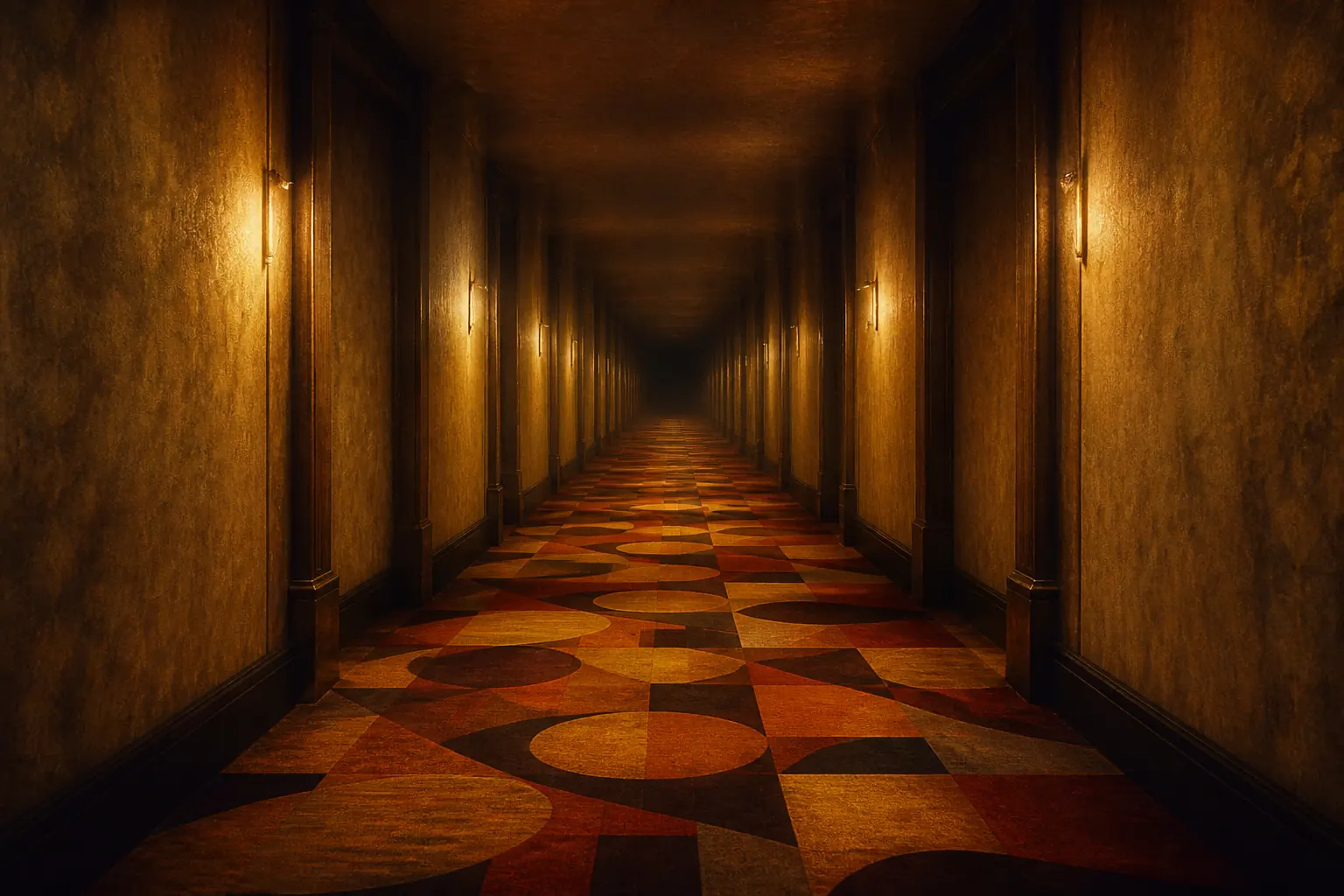
The film is in constant conversation with itself rather than with other movies, but one of its details became a reference point elsewhere. The hexagonal orange and brown carpet of the Overlook’s corridors is now instantly recognizable, and it reappears, redrawn, as the floor of Sid’s bedroom in Pixar’s Toy Story. Animators at the studio have confirmed the nod, which turns a children’s film’s most frightening location into a quiet tribute.
Kubrick’s own filmography supplies the more substantial connections. The symmetrical one-point-perspective corridors here extend a habit visible in 2001: A Space Odyssey and A Clockwork Orange, where a character is repeatedly centered in a receding architectural frame. Recognizing that as a trademark rather than an isolated flourish makes the Overlook feel less like a haunted house and more like the latest room in a single, career-long building.
Stephen King’s public dissatisfaction with the adaptation eventually produced a second version, a 1997 television miniseries made with his direct involvement. Watching the two in sequence is the clearest available demonstration of how much of the film’s unease comes from Kubrick’s spatial games rather than from the plot they share.
Cultural references explained
Ullman’s tour includes a passing remark that the hotel was built on an Indian burial ground, a line that arrives early and is never returned to. In 1980 the phrase carried a specific charge in American popular culture, functioning as shorthand for inherited guilt in dozens of horror stories. The film introduces the idea and then declines to use it, which is one reason so many later readings have tried to finish the thought on its behalf.
The Gold Room sequences are dressed as a 1920s ball, and the recurring dance music is drawn from British dance-band recordings of the period rather than composed for the film. That choice pulls the hotel’s past into the same era as the closing photograph and gives the ballroom a texture that a newly written pastiche could not.
The score is largely built from existing concert music by twentieth-century composers, including Krzysztof Penderecki and Béla Bartók, arranged and supplemented by Wendy Carlos and Rachel Elkind. Audiences who know that repertoire hear the Overlook as a place assembled out of modernist dread; audiences who do not simply feel it. Both experiences were designed.
Confirmed facts and interpretation
The Shining is the clearest case in this library of a film where verifiable production facts and elaborate reader interpretation have become tangled. The 2012 documentary Room 237 collects several of the best known readings, and it is worth watching as a document of interpretation rather than as a source of confirmed information. None of the theories it presents has support from anyone who worked on the film.
Our position is simple. Where a detail is visible on screen, we say so. Where the production record explains it, we cite that record. Where neither the director nor the crew ever addressed it, no amount of internal consistency turns a reading into a fact.
On the record
- The forbidden room number was changed from 217 to 237 at the request of Timberline Lodge, which has no room 237.
- The interiors were built at EMI Elstree Studios in England; the exteriors are Timberline Lodge in Oregon and the opening aerials are Glacier National Park in Montana.
- Garrett Brown operated his own Steadicam invention for the corridor and maze sequences.
- The repeated manuscript pages were physically typed, with alternate versions prepared for several non-English releases.
- The line delivered at the bathroom door was improvised by Jack Nicholson from a late-night television introduction.
- The Overlook carpet is reproduced as the floor of Sid’s bedroom in Toy Story, which Pixar animators have acknowledged.
Interpretation, not fact
- That the impossible window in Ullman’s office was placed deliberately to disorient the audience.
- That the typewriter changing color is an intentional signal rather than ordinary continuity drift.
- That the closing photograph proves a specific supernatural mechanism.
- That the background products, posters, and patterns in the hotel encode a hidden historical argument.
Sources consulted
The material below informed this guide. Where a claim rests on a single account, the guide says so in the relevant entry.
- Kubrick, by Michel CimentFaber and Faber. Contains extended interviews with Kubrick in which he discusses the film’s ending without settling on a single reading.
- Making The Shining (1980), directed by Vivian KubrickOn-set documentary. Filmed during production and included on subsequent home releases; the primary visual record of the Elstree set.
- The Stanley Kubrick ArchiveUniversity of the Arts London. Holds set plans, correspondence, and prop material for the production, including manuscript pages.
- Timberline Lodge visitor and press materialsTimberline Lodge, Mount Hood, Oregon. Source for the room-number change and for the extent of the location photography.
- American Cinematographer coverage of Steadicam developmentAmerican Society of Cinematographers. Documents Garrett Brown’s work on the film and the rig’s early feature credits.
- The Complete Kubrick Archives, edited by Alison CastleTaschen. Reproduces archival production documents, including alternate manuscript pages.
Spotted an error or have a documented source we should add? Write to [email protected] and read our corrections policy.