Toy Story: The Hidden Details in Andy’s Room and Next Door
The first feature-length computer-animated film established a set of hidden traditions its studio has maintained ever since. This guide covers where each one started.
Introduction
Studio traditions have to begin somewhere, and a surprising number of the recurring details that animation audiences now hunt for began in a single film released in November 1995.
Some of them are references outward, to a horror film and to a lamp from a two-minute short. Others are references forward, to films that did not yet exist, which is a strange thing for a first feature to contain and is explained by the fact that the studio had been making short work for a decade before it made a feature.
This guide takes the details individually, notes roughly where each appears, and identifies which have been confirmed by the studio. Because animation leaves an unusually complete design record, the confirmed column here is long.
Spoiler warning
This guide touches on minor plot points. It refers to events in the final act without detailing how they resolve. The detail-by-detail section below stays hidden until you choose to open it.
Film context
The studio behind the film had spent the 1980s and early 1990s producing short animation and selling rendering software, and its shorts had already established a small visual vocabulary of their own. The feature was made in partnership with Disney, which distributed it, and it was the first feature-length film animated entirely with computer imagery.
That technical constraint shaped the story. Rigid plastic toys with simple surfaces were achievable in 1995; human skin, hair, cloth, and foliage largely were not. The film is set in bedrooms, cars, and a chain restaurant partly because those environments could be built convincingly with the tools available.
The screenplay went through a difficult development, including a version rejected by the distributor that led to a production shutdown and substantial rewriting. The finished film’s tight focus on two characters is a product of that reconstruction.
It was released in November 1995 to enormous commercial success and established both a franchise and a studio. Its hidden details became a tradition because the studio survived long enough for them to recur.
The details, one by one
Each entry below carries an approximate on-screen time and a label marking whether the detail has been confirmed by the people who made the film or remains an informed reading. Running times vary between theatrical cuts, home releases, and restorations, so treat every timestamp as a signpost rather than a precise measurement.
It refers to events in the final act without detailing how they resolve. Open this section when you are ready to read the details in full.
Times refer to the theatrical version, which runs about 81 minutes.
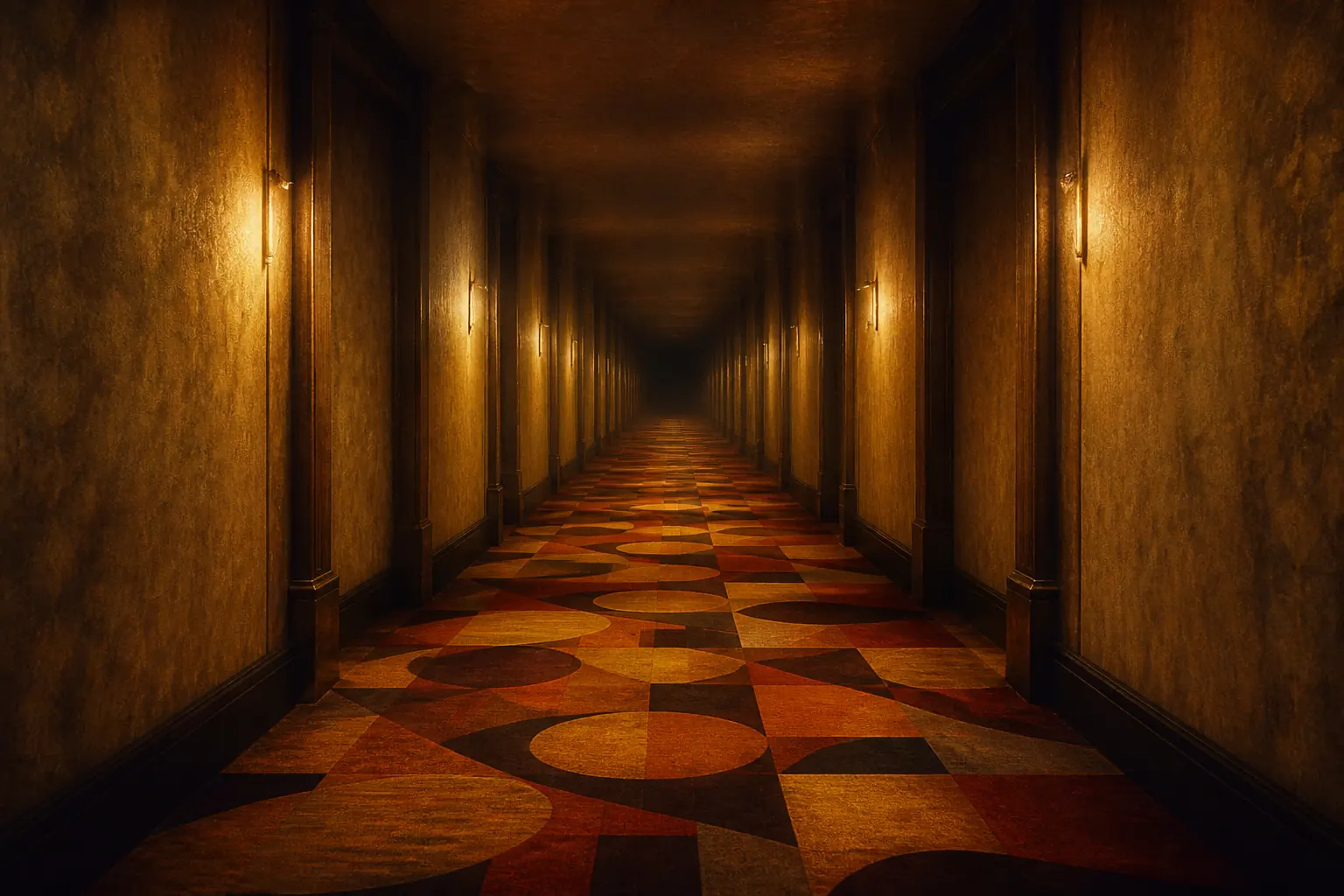
The carpet next door comes from The Shining
The floor of the neighboring child’s bedroom is covered in a hexagonal orange, brown, and red pattern reproducing the corridor carpet of the Overlook Hotel in Stanley Kubrick’s The Shining.
It is a precise joke. The film needs the audience to feel that this bedroom is genuinely dangerous, and it borrows the most recognizable floor in horror cinema to do it, in a film aimed largely at children who would not recognize the source.
The reference has been acknowledged by animators at the studio and is one of the most cited examples of a hidden detail aimed squarely at the accompanying adults. Our guide to the source film covers the original.
On the record: The pattern match is visible and the reference has been confirmed by Pixar animators in interviews and in the studio’s published art books.
The delivery truck that would appear for decades
A battered yellow pickup with a rocket-shaped sign on the roof appears during the chase to the chain restaurant. The same vehicle, or a recognizable version of it, has since appeared in nearly every subsequent feature from the studio.
It has become the studio’s most tracked recurring object, and unlike a private signature it functions as a piece of shared continuity: the truck implies that these films occupy adjacent worlds without any of them saying so.
The studio has confirmed the tradition and treats it as an established practice. Placement has become progressively more difficult as the films have moved away from contemporary American settings, which is part of the game.
On the record: The recurring vehicle has been confirmed as a deliberate studio tradition in Pixar’s published material and in interviews with its directors.
The striped ball comes from a 1986 short
A ball with a blue and yellow stripe and a red star appears early in the film and recurs across the studio’s work. It originates in Luxo Jr., a two-minute short made in 1986 in which a desk lamp plays with exactly that ball.
The lamp from the same short became the studio’s logo, which makes the ball the logo’s co-star. Placing it in the feature was a way of carrying a decade of short-film work into a first feature.
It is worth noticing how the ball is used rather than merely that it appears. In several later films it turns up in moments of unease, functioning as a small marker of a childhood the characters have left.
On the record: The ball’s origin in Luxo Jr. is a matter of record, and its recurrence has been confirmed by the studio as a deliberate practice.
The license plate carries the animators’ room number
The family car’s license plate reads A113, a reference to a classroom in the character-animation program at the California Institute of the Arts, where several of the film’s senior staff trained.
This is the most frequently cited appearance of a code that has since turned up across studios and decades, and in one later film became a plot device. Our dedicated guide to the code covers its origin and its confirmed appearances.
For this film, the significant point is that a professional in-joke was placed in a first feature before anyone knew there would be a second.
On the record: The plate is visible in the film, and the CalArts origin of the code has been confirmed by multiple animators including several who worked on this production.
The toy packaging is fully written
The packaging for the newly arrived toy is designed as real product packaging, with a logo, a marketing slogan, feature callouts, and small-print disclaimers, including a warning that the toy is not intended for flight.
That last line is a joke with a payoff, since the film’s central argument between its two leads is precisely about whether the character can fly. The packaging states the answer in a footnote in the first act.
Fully designed packaging is standard practice in animation because a blank box reads as unfinished. What is less standard is hiding a thematic statement in the legal small print.
On the record: The packaging design is visible in the film and is reproduced in the studio’s published art material for the production.
The wallpaper and the sky do the same work
The child’s bedroom is papered with a cloud pattern, and the film repeatedly frames its characters against it. The same motif recurs in later films from the studio, where it is used to signal safety and childhood.
Within this film the pattern is doing something more specific. It gives the interior a false sky, which matters in a story about a character who believes he can fly and a room he cannot leave.
The design has been discussed by the studio’s art department as a deliberate motif rather than a neutral choice of decoration.
On the record: The wallpaper motif and its later reuse are documented in Pixar’s published art books and in interviews with the studio’s production designers.
Claimed references to specific real toy lines
Compiled lists frequently identify background toys as specific licensed products or as references to particular commercial lines from the period. Some of the film’s toys are indeed licensed and identifiable; many are original designs built to resemble a category rather than a product.
The distinction matters legally as well as editorially. A studio must clear a recognizable product, so genuine appearances leave a paper trail, and designs invented to evoke a type do not.
Where a toy is not credited or acknowledged, treat the identification as a resemblance rather than a reference.
On the record: Licensed toys appearing in the film are credited; unattributed identifications in compiled lists have no production confirmation.
Connections to other films
The most direct connection runs to The Shining, whose most famous floor covering was reproduced here. Two films could hardly be further apart in intended audience, which is precisely why the borrowing works.
Within the studio’s own output, this film is the origin point for at least three traditions covered elsewhere in this library: the recurring delivery truck, the striped ball, and the room-number code. Reading the A113 guide alongside this one shows a signature becoming an institution.
The film also sits at a technical hinge. Its constraints, and the way its story was built around them, established a pattern in which animation studios chose subjects that matched their tools, a habit visible in the following decade of computer-animated features about toys, cars, insects, and fish.
Cultural references explained
The film depicts a specific American toy culture of the early 1990s, in which television advertising drove seasonal demand and a new product could displace an established favorite within weeks. The plot is a story about obsolescence, and the setting is the market that produces it.
The chain restaurant sequence parodies a real category of American family entertainment venue, combining arcade machines, animatronic performers, and pizza. Audiences who grew up with those establishments read the sequence as documentary; everyone else reads it as invention.
The film’s treatment of a child’s bedroom as a complete world with its own politics belongs to a long literary tradition, running through nursery stories in which toys have interior lives. The film updates the tradition by giving the toys a market to worry about.
Confirmed facts and interpretation
Animation is the best documented medium for this kind of work. Every object in the frame was built by someone, art departments publish their design material, and studios discuss their traditions openly, which is why so much here can be confirmed.
The interpretation column consists mainly of over-identification, where background designs built to resemble a category of product are read as references to specific ones.
On the record
- The neighboring bedroom’s carpet reproduces the Overlook Hotel corridor pattern from The Shining.
- The Pizza Planet delivery truck introduced here became a recurring object across the studio’s later films.
- The striped ball originates in the 1986 short Luxo Jr., whose lamp became the studio’s logo.
- The family car’s license plate carries the A113 CalArts classroom reference.
- The toy packaging is fully designed, including small print that states the film’s central argument.
- The cloud wallpaper is a deliberate motif reused in the studio’s later work.
Interpretation, not fact
- That unattributed background toys reference specific commercial product lines.
- That the placement of the striped ball in this film was planned as a recurring device from the outset.
- That individual background posters in the bedroom contain further film references.
Sources consulted
The material below informed this guide. Where a claim rests on a single account, the guide says so in the relevant entry.
- The Art of Toy StoryChronicle Books. Production art, design material, and interviews covering the film’s environments and props.
- To Infinity and Beyond! The Story of Pixar Animation Studios, by Karen PaikChronicle Books. Studio history documenting the shorts that supplied the film’s recurring objects.
- Interviews with Pixar animators on studio traditionsWired, Empire, The Hollywood Reporter. Confirms the recurring truck, the ball, and the A113 code as deliberate practices.
- Luxo Jr. (1986)Pixar. Consulted directly as the origin of the striped ball and the studio’s logo.
- Contemporary reporting on the film’s production and release, 1993–1995Variety, The New York Times. Documents the development shutdown, the rewriting, and the technical constraints.
Spotted an error or have a documented source we should add? Write to [email protected] and read our corrections policy.