The Matrix: The Visual Clues Planted Before the First Reveal
The film tells you what kind of world you are looking at through color, numbers, and set dressing. This guide identifies the system and marks where the reading outruns the record.
Introduction
Almost every discussion of The Matrix begins with philosophy, which is understandable and slightly unfortunate, because it skips the more interesting question. Before the film explains anything, it has already told the audience how to read its images.
The mechanism is mostly color. Two visual environments exist in the film, and they are graded differently, consistently, from the first shot to the last. Once you notice, the film becomes almost impossible to get lost in, even during sequences that cut rapidly between them.
Around that system sits a set of smaller planted details: a book used as a hiding place, a repeated room number, a nameplate carrying a biblical reference, and a stream of characters whose origin is much funnier than its reputation suggests. This guide takes each in turn and states what the record supports.
Spoiler warning
This guide discusses mid-film revelations and some plot turns. It discusses the central revelation about the nature of the world and the ending. The detail-by-detail section below stays hidden until you choose to open it.
Film context
The Wachowskis wrote the screenplay in the mid-1990s and made Bound first, partly to demonstrate they could direct. The production that followed was shot largely in Sydney across 1998, with fight choreography by Yuen Woo-ping and a training period of several months for the principal cast before photography began.
The film’s technical reputation rests on a photographic technique the production called bullet time, built from arrays of still cameras firing in sequence to create the impression of a camera moving through a frozen moment. It was not the first attempt at the effect, but it was the first to be integrated into a film’s action grammar rather than used as a novelty.
The directors also assembled an unusually explicit intellectual apparatus. Cast members have described being given a reading list before production, including works of critical theory, and the film’s dialogue and set dressing carry those references openly.
It was released in March 1999 and became one of the defining films of its decade. Its visual language, particularly the green cast and the falling characters, entered advertising and design so thoroughly that the original choices can be difficult to see freshly.
The details, one by one
Each entry below carries an approximate on-screen time and a label marking whether the detail has been confirmed by the people who made the film or remains an informed reading. Running times vary between theatrical cuts, home releases, and restorations, so treat every timestamp as a signpost rather than a precise measurement.
It discusses the central revelation about the nature of the world and the ending. Open this section when you are ready to read the details in full.
Times refer to the theatrical version, which runs about 136 minutes.
Two worlds, two colors, applied without exception
Every sequence set inside the simulation carries a green cast. Every sequence set in the physical world outside it carries a cold blue cast. The scheme is applied consistently enough that you can identify where a shot takes place with the sound off.
Cinematographer Bill Pope has described the two-palette approach as a deliberate device developed with the directors, achieved through lighting, filtration, and laboratory work rather than added afterward. The green was intended to evoke the phosphor glow of older computer monitors.
The scheme also has a narrative function beyond orientation. Because the audience learns to associate green with artifice, the film can create unease simply by tinting a frame, which it uses repeatedly in the final act.
On the record: Bill Pope has discussed the two-color grading strategy in interviews with American Cinematographer and in the film’s production documentation.
The hollowed book is a real work of theory
Early in the film, the protagonist retrieves a data disc from inside a hollowed-out book. The book is Jean Baudrillard’s Simulacra and Simulation, a 1981 work of French theory concerned with copies that have no original, and the prop opens to a specific chapter.
The reference is not decorative. Cast members have said the directors gave them the book to read before production, and the film’s central conceit is a dramatization of the argument at its center. The choice to make the book a hiding place, hollowed and functionally destroyed, is a joke worth noticing.
Baudrillard himself later objected publicly to the film’s use of his work, arguing that it misunderstood him. That disagreement does not affect the confirmation that the reference is deliberate, and it makes the film a rare case where the cited author responded in print.
On the record: The prop is identifiable on screen; the reading assignment has been described by cast members including Keanu Reeves, and Baudrillard’s objections appeared in interviews with Le Nouvel Observateur and were widely republished.
The number 303 marks the beginning and the end
The film opens on a police raid at room 303 of a hotel, and its final act returns to the same room number, where the protagonist is killed and then revives. The recurrence is visible and verifiable.
Readings of the number range from the ordinary, that a returning location naturally reuses its own room, to the elaborate, involving numerology and resurrection symbolism. The structural symmetry is certainly deliberate; the film goes out of its way to return to the same door.
What has not been documented is a stated meaning for the digits themselves. We list the symmetry as observable and the numerology as interpretation.
On the record: The room number is visible in both sequences; no production account we located assigns a specific meaning to the number.
The ship carries a biblical nameplate
A plate mounted inside the hovercraft identifies the vessel as the Nebuchadnezzar, along with a manufacturing designation and the year. Nebuchadnezzar is the Babylonian king of the Book of Daniel who is tormented by a dream he cannot remember and demands that someone both recover and interpret it.
The choice is precise rather than generally biblical. A film about people trying to wake from a dream they cannot recall, in a vessel named for a king with exactly that problem, is making an argument through set dressing.
The same naming logic runs across the film. The last human city, the character named for the god of dreams, and several crew names all draw from religious and mythological sources, which the directors have discussed as a deliberate register.
On the record: The nameplate is visible in the film; the Book of Daniel supplies the reference, and the Wachowskis have discussed the film’s mythological naming in interviews around its release.
The falling code was made from a cookbook
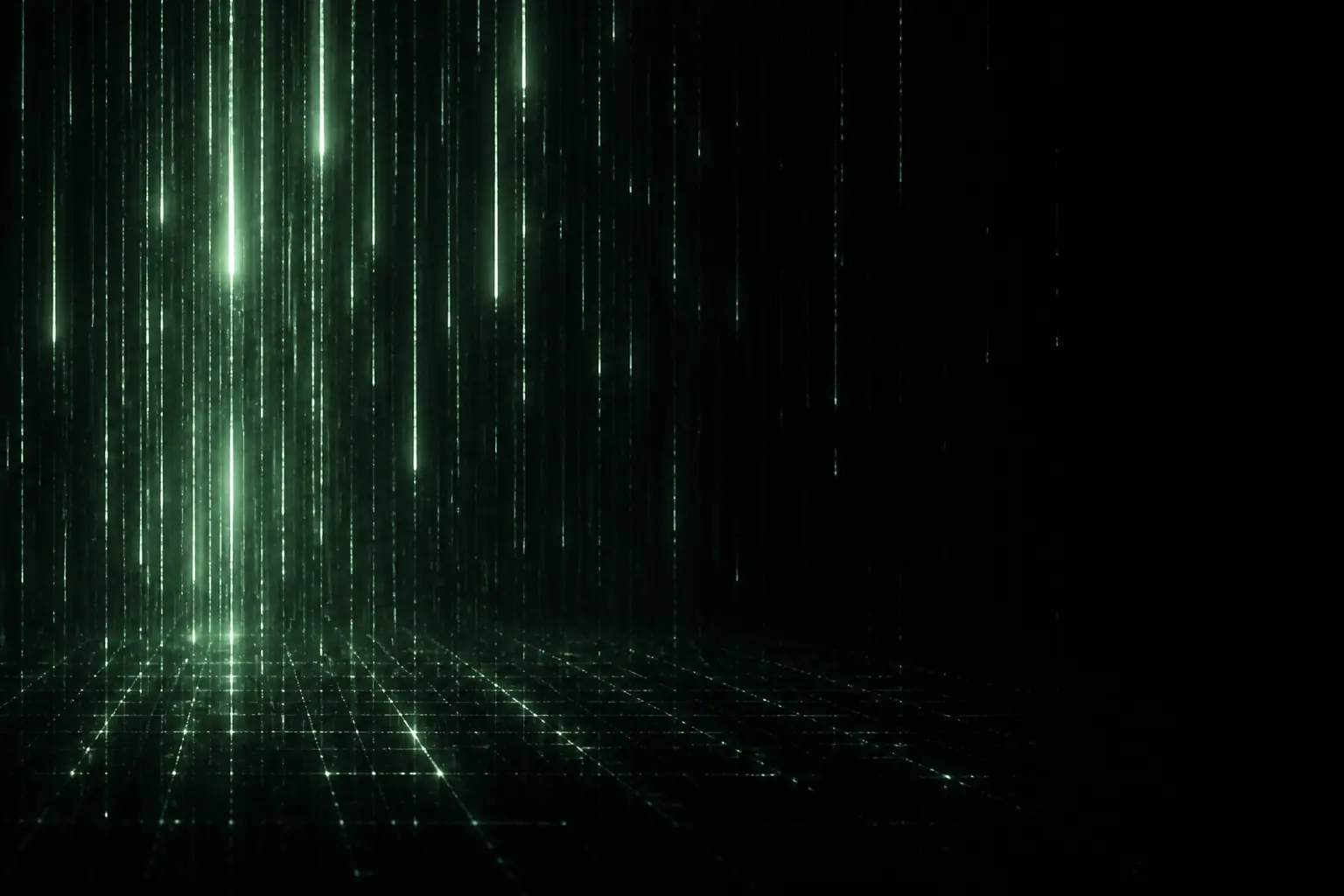
The cascading green characters that open the film and recur throughout were designed by Simon Whiteley, who has said publicly that he built the glyphs by scanning characters from his wife’s Japanese cookbooks and reversing and modifying them.
The detail is genuinely funny and genuinely useful. It explains why the characters resist recognition: they are neither a real writing system nor pure invention, but a distorted set of real glyphs, which is exactly the uncanny quality the sequence needs.
It is also a good reminder of how film design often works. The most recognizable digital motif of its decade came from a domestic bookshelf and a flatbed scanner.
On the record: Simon Whiteley described the origin of the code in interviews with CNET and other outlets, confirming the use of scanned characters from Japanese cookbooks.
The passport with an unsettling expiry date
During the interrogation sequence, a passport is shown on screen with an expiry date corresponding to September 11th, 2001. The date is legible on high-resolution home releases and has been noticed by a great many viewers.
The film was made in 1998 and released in March 1999, more than two years before the date in question acquired its present meaning. There is no plausible mechanism by which the choice could have been intentional in the way it is often described.
This is the clearest example in this library of a coincidence that reads as a plant. The date is really on the prop; the significance attached to it belongs entirely to hindsight.
On the record: The date is visible on the prop in high-resolution releases. The film’s production and release predate the events with which the date is now associated.
The Lewis Carroll references are spoken aloud
The film invokes Alice’s Adventures in Wonderland directly in dialogue, twice, and stages a scene around following a white rabbit tattoo. This is the least hidden reference in the picture and it is worth including precisely for that reason.
Carroll’s book supplies the structure the film needs: a protagonist who accepts an invitation into a world with different rules and must learn which of those rules can be broken. The mirror scene later in the film extends the borrowing to Carroll’s sequel.
When a reference is spoken by a character, it needs no interpretation. The distinction between this and the numerology around the room number is exactly the distinction this guide exists to make.
On the record: The references appear in the film’s dialogue and are listed in the published screenplay.
Connections to other films
The film’s action grammar comes from Hong Kong cinema, through the direct participation of choreographer Yuen Woo-ping, whose work with wire assistance had defined the style over the previous decade. Watching his earlier films makes clear how much of what looked new in 1999 was an import rather than an invention.
Its visual and conceptual debts to Japanese animation are extensive and acknowledged. The directors have cited Ghost in the Shell in particular, and the falling-code motif, the diving-into-networks imagery, and the treatment of the body as equipment all belong to that tradition.
Downstream, the two-color grading system became one of the most imitated ideas in commercial filmmaking, to the point that teal-and-orange grading dominated the following decade. The specific green here is rarer, because it is doing narrative work rather than simply looking modern.
Cultural references explained
Baudrillard’s Simulacra and Simulation belongs to a body of late-twentieth-century French theory concerned with media saturation, and it was widely taught in American universities in the 1990s. Its appearance in a studio action film is a genuine artifact of that moment, when critical theory had unusual currency in popular culture.
The religious vocabulary the film uses, drawing on Christian, Jewish, Buddhist, and Gnostic sources, was already familiar from science fiction literature. What was new was the willingness to keep the names undisguised, so that a viewer with any exposure to those traditions receives a continuous stream of signals.
The film’s costume design, built from long coats, small dark glasses, and industrial fabrics, drew on club and fetish subcultures of the 1990s rather than on prior screen science fiction. That borrowing shaped a decade of fashion, which is an unusual afterlife for a set of costumes designed to look inhuman.
Confirmed facts and interpretation
This film has generated an enormous secondary literature, much of which treats every visible number and name as a solvable puzzle. The production record supports a great deal of deliberate reference, and it does not support the more systematic decoding.
The passport date is the case that best illustrates why the distinction matters. It is a real detail, on a real prop, that means nothing, and no amount of significance assigned in hindsight can change when the film was made.
On the record
- The simulation and the physical world are graded green and blue respectively, as a deliberate orientation device.
- The hollowed book is Jean Baudrillard’s Simulacra and Simulation, assigned to the cast as reading before production.
- Baudrillard publicly disputed the film’s use of his ideas.
- The hovercraft nameplate references the biblical Nebuchadnezzar, a king tormented by a forgotten dream.
- The falling code was built from scanned and modified characters taken from Japanese cookbooks.
- Alice’s Adventures in Wonderland is referenced directly in the dialogue.
Interpretation, not fact
- That the repeated room number carries numerological or resurrection symbolism.
- That the passport expiry date was a deliberate plant of any kind.
- That every crew member’s name encodes a specific mythological argument about their role.
Sources consulted
The material below informed this guide. Where a claim rests on a single account, the guide says so in the relevant entry.
- American Cinematographer coverage of The Matrix, 1999American Society of Cinematographers. Documents Bill Pope’s two-palette grading approach and the photographic techniques used.
- Simulacra and Simulation, by Jean BaudrillardUniversity of Michigan Press. The work used as a prop and as a conceptual source; consulted directly.
- Interviews with Simon Whiteley on the design of the falling codeCNET and other outlets. First-hand account of the code’s origin in scanned Japanese cookbook characters.
- The Art of The MatrixNewmarket Press. Reproduces storyboards, the shooting script, and design material for the production.
- Baudrillard interview on the filmLe Nouvel Observateur. The philosopher’s own published objection to the film’s reading of his work.
Spotted an error or have a documented source we should add? Write to [email protected] and read our corrections policy.